

Set amongst rolling plains dotted with olive trees and cork oaks, Arraiolos is a small Alentejo town – not far from Lisbon or Évora – with a cool and unique craft culture. Over centuries, women of the quiet vila have hand-stitched a legacy of carpet weaving.
I’ve visited Arraiolos several times over the years, drawn in by the town’s colourful rugs and unique food traditions. It’s an offbeat Portuguese destination shaped by artisans, agriculture and a slower rhythm of life. If you have a day – or even a half-day – you can explore the highlights on a day trip from Lisbon or Évora.
Planning tip: Add Arraiolos to your wider Alentejo itinerary – and sleep in a gorgeous tile-filled 16th-century convent!

How to get to Arraiolos
Arraiolos is located just 20 minutes from Évora, the Alentejo capital and a popular base for exploring the region. From Lisbon, the drive takes around 1 hour and 20 minutes, mostly along the easy A6 motorway.
By public transport, Rede Expressos coaches run infrequent services between Lisbon and Arraiolos, and the journey takes closer to 1 hour and 45 minutes. Once in town, everything is walkable.
Morning: Explore the castle & heritage of Arraiolos rugs
Arraiolos is most famous for its rugs. Heavy, cross-stitched woollen carpets that date back many centuries. The exact origins are a bit of a mystery. The oldest documented reference dates to 1598, but archaeological excavations in the area have uncovered ancient dyeing vats, suggesting that textile production in Arraiolos may go back much further.

The designs themselves tell stories of Portugal’s history. Many early patterns were inspired by Oriental and Indo-Persian motifs, likely influenced by imported carpets from Turkey and Persia that reached Portugal during the Age of Discoveries. Over time, locals developed the distinct style of Arraiolos carpets, stitching wool dyed in rich, earthy tones onto a coarse linen canvas.


A great place to start your exploration of Arraiolos’ rug-making history is the Centro Interpretativo do Tapete de Arraiolos, a modern and well-curated museum dedicated to the craft. Here you’ll see rugs dating back to the 17th and 18th centuries, alongside contemporary works that show how the tradition continues to evolve. As a bonus, you’ll usually see an artisan actively weaving a rug inside the museum, showcasing just how labour-intensive it is to create a full-size tapete. It takes months, stitch by stitch, to finish a single piece.

Event: Each year in early June, Arraiolos hosts O Tapete está na Rua, a festival celebrating the town’s famous craft. The streets turn into an open-air gallery with rugs displayed on walls and balconies, live weaving demonstrations and workshops, plus, like any good Portuguese party, street food, wine and music.
Stop for an empada de Arraiolos
Every village, town and city in Portugal has a signature treat. Usually it’s a historic sweet recipe, invented in a convent – but Arraiolos is famous for its savoury pies. The empada de Arraiolos is a small, dense pie encased in crumbly pastry and traditionally filled with shredded chicken.


Today you’ll also find versions made with duck, pork, game meats or vegetables – and it’s worth noting that the pastry is traditionally made with pork fat, so vegetarians should ask before ordering. One of the best places to try one is at a café on the main square (Praça do Município) near the museum, ideally paired with a coffee or a glass of wine if it’s closer to lunchtime.
While you relax in the square, stop to admire the marble mosaic tapete underfoot and take a moment to spot the Pelourinho de Arraiolos, a 16th-century pillory carved from Estremoz marble, with its spiral column topped by a stone sphere.
Shop for rugs across the historic centre
Keep exploring Arraiolos carpets with a visit to one of the half-dozen artisan workshops scattered around the historic centre. Traditionally, these rugs were woven by women, with techniques and patterns passed down through generations. While the industry has changed, several family-run ateliers still operate today.

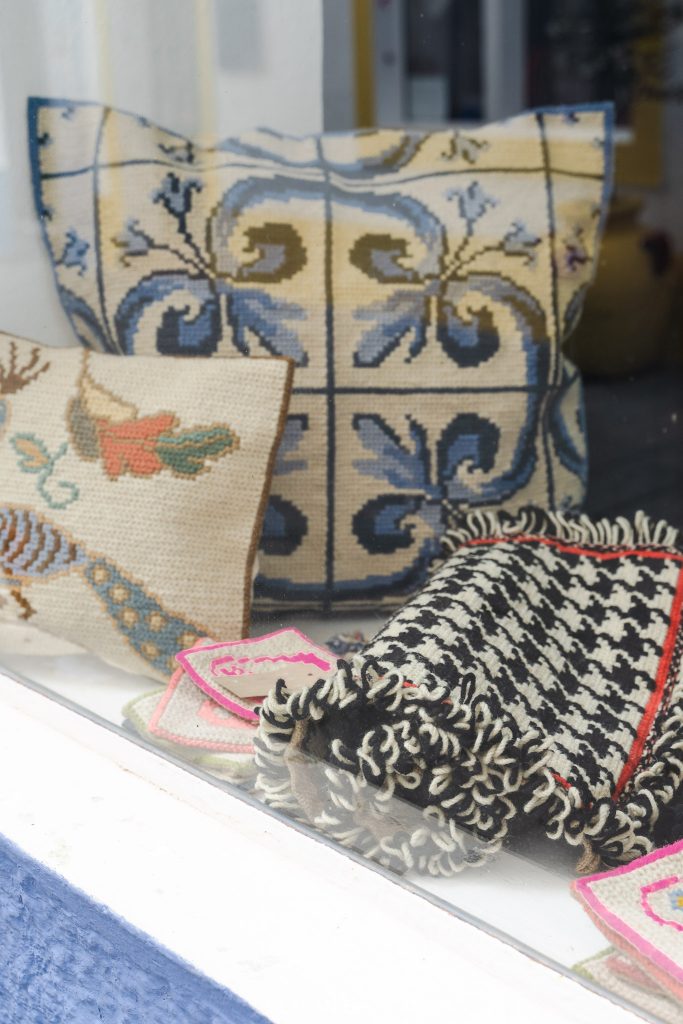


Depending on your budget (and luggage space), you can shop for anything from a full-size rug to smaller pieces like cushion covers, table runners or bags. Prices reflect the time and skill involved, but buying directly from a workshop helps to support the continuation of the craft.
Here’s a list of rug workshops to visit (with Google Maps links):
- Fábrica de Tapetes Hortense
- Fracoop – Fraternidade Cooperativa de Artesanato de Tapetes de Arraiolos
- Sempre Noiva – Tapetes de Arraiolos
- Tapeçaria Arraiolos – Maria do Sameiro
- Tapetes Arte em Casa
- Tapetes de Arraiolos Lóios
- Casa Tiraz
Tip: As you wander the old town, pop into the Igreja da Misericórdia. Inside, you’ll find beautiful azulejo panels from 1753 and traditional tapetes laid across the floor.
Head up to the Castelo de Arraiolos

Before lunch, make your way uphill to the Castelo de Arraiolos. Built in the early 14th century during the reign of King Dinis, the castle is unusual for its circular walls. Although strategically important, the exposed, windswept hilltop proved less appealing for everyday life, and residents gradually moved downhill.
Today, the reward for the climb is the view over the town. From the ramparts, you can see whitewashed houses cascading down the slope, framed by vineyards, farmland and the vast openness of rural Alentejo.


Inside the walls stands the Igreja do Senhor Jesus dos Passos, dating back to the same time as the castle itself and carefully restored in the 19th century. Nearby lie the ruins of the Paço dos Alcaides, once the residence of the castle’s governors.
Lunch: O Alprende, an Alentejano classic

O Alprende, open since 1999, is a fantastic spot for a hearty and traditional Alentejo lunch, which might be my favourite regional expression of Portuguese food. Alentejo gastronomy is rooted in peasant cooking – simple, seasonal ingredients that make the most of what the land provides.
Enter the cosy space, with brick arches and walls adorned with agricultural artifacts, to find an array of traditional snacks laid out across your table, draped in a white cloth. In Portugal, you can always ask the waitstaff to remove the snacks you don’t want (and you’ll only be charged for what you keep), but definitely keep a serve of the town’s signature empadas. We sent away some petiscos but kept the bacalhau (salted cod) and chickpea salad, sauteed mushrooms and a plate of presunto – Portugal’s dry-cured ham, which is quite different from Italian prosciutto.

For mains, we ordered grilled black pork with asparagus migas – a classic Alentejo side made from yesterday’s bread, garlic, olive oil and seasonal greens – and carne de porco à alentejana, a dish that combines the land and the sea (clams and pork) with fried potato cubes. The portions are generous, and this was more than enough to share between the four of us!
Dessert is hard to resist here, especially if you have a soft spot for Portuguese convent-style sweets, rich with egg yolks and sugar. I can never say no to sericaia, a light and fluffy, eggy sponge dusted with cinnamon and traditionally served with ameixa d’Elvas, a syrupy preserved plum from nearby Elvas. But in Arraiolos, the must-try is the pastel de toucinho – a local specialty made with bacon, ground almonds, egg yolks and sugar.
Reserve a table in advance, especially on weekends or if you’re visiting during festival season.
More places to eat in Arraiolos: For somewhere more relaxed, try Tasquinha da Vila or República do Petisco.
Afternoon: visit a winery or nature time
Like most Alentejo towns, Arraiolos slows right down in the early afternoon, especially in warmer months. Between lunch and late afternoon, the sun can be intense and the streets noticeably quieter. It’s a time to either escape into nature or retreat to the cool of a winery.
Option 1: Get out into nature


If you’re craving fresh air and open landscapes, the area around Arraiolos offers several well-marked walking and cycling trails, many of them gentle and suitable even if you’re not a hardcore hiker. The local tourism website lists four routes of varying lengths.
One easy option close to town is the Passadiço de Arraiolos, a wooden walkway designed for walking and cycling. It’s flat and accessible. If you’re up for a longer walk, the PR4 – Rota da Sobreira Grande is a rewarding loop trail of around 10 km (6 miles). The highlight is seeing the Sobreira Grande, a monumental cork oak that was voted Portugal’s Tree of the Year in 2022.
Or take a short drive to see a lesser-known megalithic site. The Cromeleque de Vale Maria do Meio is just 15 minutes from Arraiolos and has 34 menirs; or you can visit the more famous Cromeleque dos Almendres, about 30 minutes away near Évora.
Option 2: Spend the afternoon at a winery
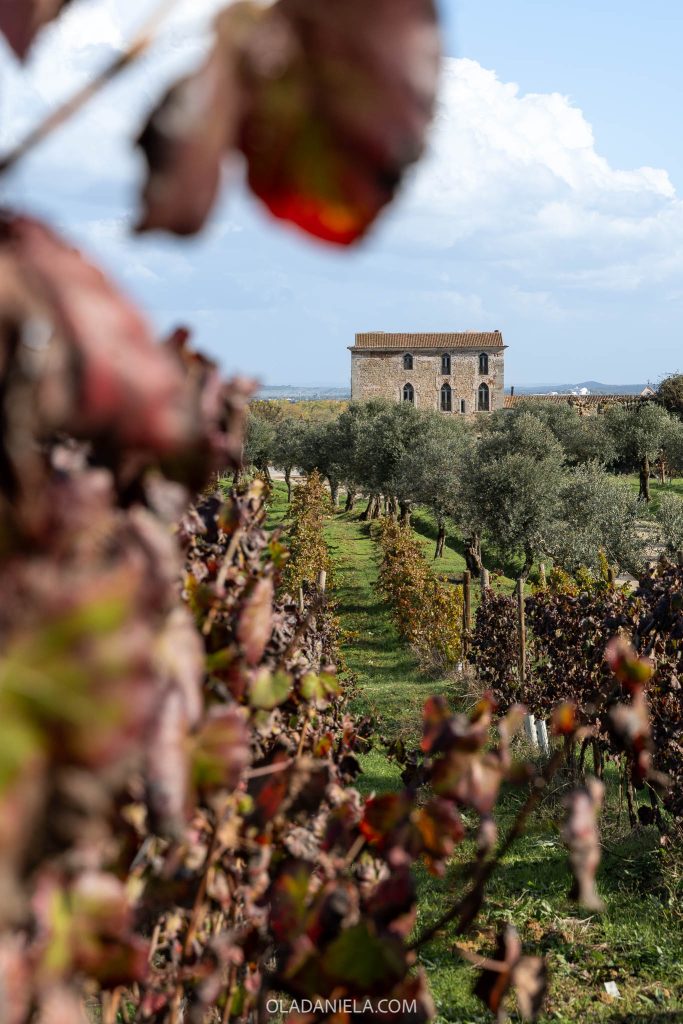
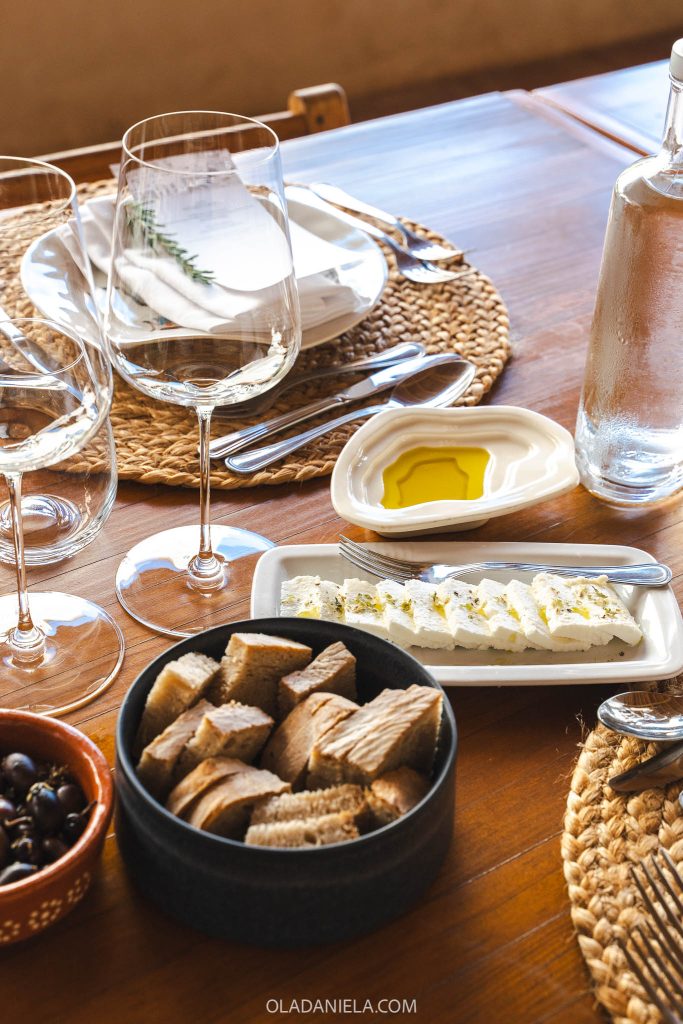
The early afternoon is a lovely time to visit one of the gorgeous wine estates surrounding Arraiolos. My pick is Fitapreta Vinhos (pictured), a stunning, modern winery set in the most insane medieval building. Winemaker António Maçanita makes expressive Alentejo wines, blending tradition with experimentation. Drop into the wine bar, or book a tasting (there’s a 3-wine, 5-wine or 7-wine option) to explore the vineyards and historic cellars.
Alternatively, combine wine and nature at Tapada de Coelheiros. This family-run estate is set within 800 hectares of cork forest. This 2-hour cork-and-wine experience takes you on a Jeep tour through the montado (cork forests) and vineyards, followed by a tasting of five premium wines with cheese and charcuterie. There’s also an option that includes lunch.
Nearby you’ll also find Herdade da Ravasqueira, one of the region’s best-known estates. It offers vineyard tours, tastings and a shop featuring local products.
Book winery visits ahead! ⚠️ Most wineries require a booking in advance, especially for guided visits or tastings, so it’s worth planning a few days ahead.
Can you drink and drive in Portugal? If you’re driving, the maximum allowed alcohol level in Portugal is 50mg per 100ml of blood – so even a single glass can tip you over the limit.
Evening: Check into the convent hotel
Hotels with history are my favourite kind, so the Pousada Convento Arraiolos is a winner. Set within the Lóios Convent, founded in 1527, it sits just outside the town in a beautifully isolated spot overlooking a wide, green valley – the kind of place that encourages you to slow down.
Check your dates here ➡️ Pousada Convento Arraiolos


The former Convento dos Lóios, also known as the Convento de Nossa Senhora da Assunção, blends Gothic, Manueline and Baroque architectural elements. After centuries of religious use, the convent was converted into a hotel in the 1990s. While I’m yet to sleep over myself (#oneday), I’ve dropped in twice to explore the grounds and admire the 18th-century tiles that line the main chapel. Spanish master Gabriel del Barco painted blue-and-white tiled scenes of biblical episodes and stories from Portugal’s history. Even if you’re not staying here, it’s worth visiting just to see them.

As you’d expect from a pousada (historic palace or convent hotel), the facilities are modern yet fit the space. There’s an outdoor swimming pool for the warmer months, a heated indoor pool kept at around 26ºC (79ºF), as well as a gym, massage room, tennis court, restaurant and bar. The reception team can also help organise cycling, horse riding and hiking in the surrounding countryside – a nice option if you’re staying longer than a night. The hotel is also dog-friendly (for an additional fee).
Other things to do and see around Arraiolos
In Arraiolos:
- Monumento à Tapeteira de Arraiolos: A modern fountain and sculptural tribute to the women who have kept the town’s rug-making tradition alive for centuries.
- Casa dos Arcos: One of the oldest noble houses in town, with parts of the manor dating back to the 16th century. You can walk by to see the distinctive arches and aura of Arraiolos’ aristocratic past.
Towns to visit nearby:
- Évora (20 minutes): A UNESCO World Heritage city and must-visit addition to your itinerary. Don’t miss the Roman Temple, Cathedral of Évora and Capela dos Ossos. I have a 48-hour Évora itinerary here.
- Evoramonte (25 minutes): A beautifully preserved hilltop village crowned by an unusual 15th-century castle. Here, the Concession of Évoramonte was signed in 1834, effectively ending the Portuguese Civil War.
- Estremoz (35 minutes): Known for its white marble quarries and quaint historic centre. Don’t miss the lively Saturday market – one of the best in the Alentejo.
- São Pedro do Corval (35 minutes): Portugal’s biggest pottery village, known for its traditional clay workshops. A good stop if you’re interested in Portuguese craft (even more crafts to explore here!)
- Monsaraz (45 minutes): A surreal medieval hilltop village overlooking the Alqueva lake. Slate cobblestone streets, castle views and dramatic Alentejo sunsets.
That’s my guide to Arraiolos – keep exploring the Alentejo with my other guides to the region!
Keep reading…
- 20 best things to do in Évora, the Alentejo capital
- Where to eat in Évora: The Best Restaurants, Cafés & Sweets
- Portuguese artisans: 10 traditional crafts from the Alentejo
- 22 most beautiful castles in Portugal
- 48 hours in Monsaraz
- Portugal’s pottery village: Why you should visit São Pedro do Corval
- The best things to do in Estremoz
- The average person’s guide to A-list Comporta: Portugal’s luxe beach town
- Bottomless wine and secret cellars: Redondo’s tasca and talha trail