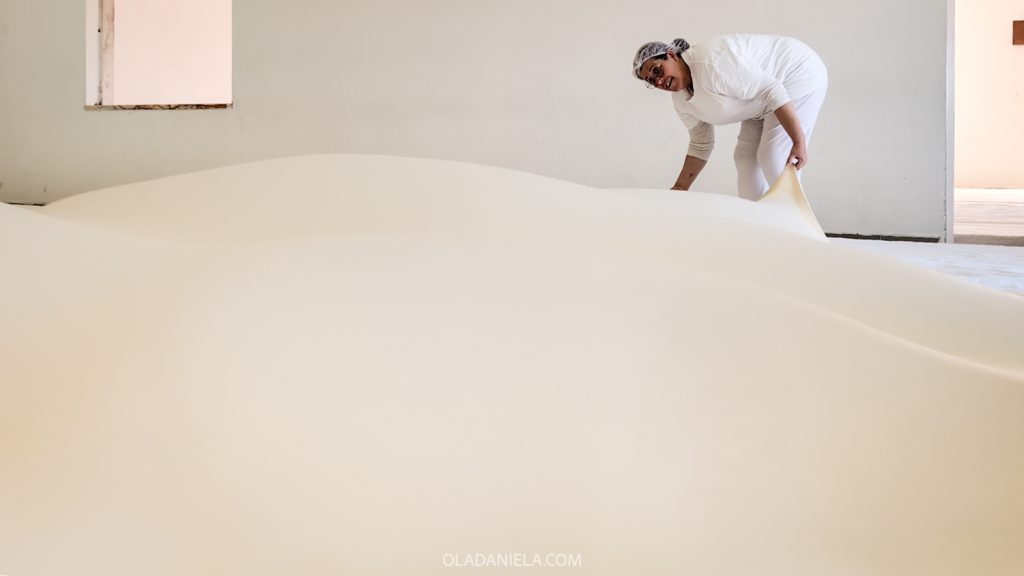
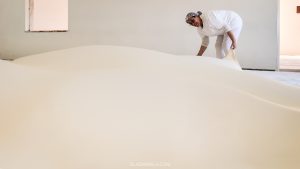
Isabel Rama works in silence. Circling the mound, she grabs fistfuls of the heavy dough, stretching it out and slapping it down in her own rhythm. From the first touch, an air bubble forms, growing larger and larger as she circles again and again, pulling and tugging at the sides until a paper-thin pastry sheet covers the floor.
Now the room is a silent sea of wobbling dough. It billows as Isabel, holding one edge, creates a gentle ripple across the translucent film that will soon become one of Portugal’s most fascinating convent sweets.
The all-important pocket of air trapped under the flowing fabric helps stretch the elastic dough to its limits. But it does have limits. Stretch it too much, and you’ll create holes; too little, and it won’t have the ultra-thin consistency needed.
It’s a fine line balancing a delicate touch with brute strength. This dough dance is an art form learned over decades, influenced by the seasons, and passed down through generations of women in one small village in Portugal.
We’re in Tentúgal, a village of 2,000 inhabitants in central Portugal, famous for its namesake sweet – the Pastel de Tentúgal. This crispy, delicate pastry log is filled with a velvety egg-yolk cream.
Across Portugal, hundreds of sweets were invented by religious orders to make the most of a surplus of egg yolks. Combining the yolks with sugar preserved them longer, and so a sweet golden egg cream forms the basis of most traditional convent sweets. In Tentúgal, cloistered Carmelite nuns at the nearby Convent of Nossa Senhora da Natividade invented and began selling the sweet in the 16th century to cover the convent’s upkeep.
In 1834, Portugal abolished all religious orders, only allowing existing nuns to remain. When the last Tentúgal nun died in 1898, the pastry could have disappeared with her – but luckily the tradition and knowledge were passed down orally to local women, who went on to open bakeries and dedicate their lives to making this now-iconic sweet.
Today the Pastel de Tentúgal is recognised with an IGP (Protected Geographical Indication) seal, although, despite the love for this sweet, its footprint is shrinking. So much so, The New York Times recently visited Tentúgal as part of its Before It Disappears series, which covers gastronomic traditions at risk.
While Tentúgal once had dozens of bakeries, now just nine continue to produce the labour-intensive sweet. One of those is Pastelaria Afonso, where we’re met by Olga Cavaleiro, a vocal advocate for Portugal’s food traditions. Her mother Natália learnt how to make the pastéis at age 12, and opened the family bakery in 1970. The day-to-day operations are now overseen by her sister Margarida, and the Cavaleiro family continues to employ local women and bake various traditional sweets.
“We are a group of women who believe that this is part of our families… more than a brand, it’s like a fingerprint,” Olga says, describing how connected they feel to this art. “I used to say that this kind of dough is like a second skin for me. All of us feel it very deeply, and we believe that we can make our future with this.”
Seeing the magic at Pastelaria Afonso
Olga and her clingy rescue dog lead us to the back building where an empty white room – larger than our two-bedroom flat in Lisbon – is covered in white cotton sheets. In one corner, we meet experienced baker Isabel, dressed in white cotton, as she prepares the dough.
Olga tells us Tentúgal’s signature pastry is a relationship between the baker and the dough. After decades, Isabel knows what it takes to get it right, adapting to the seasons, humidity and temperature of each day.
First she mixes a super fine flour, as soft as silk, with water until the consistency is just so. As the gluten develops its elasticity, Isabel uses a needle to make sure no bubbles form in the batter. Once happy, she lugs a circular silver tray, topped with her huge six-kilogram (13-pound) mound of heavy dough, to the centre of the room and flips the contents onto the white cotton sheet.
Tentúgal’s physically demanding dough dance begins with her pressing her whole hand into the centre of the dough. It’s a ritual that both tests the dough’s consistency and leaves her mark.
“Now we have to wait. This is a process made with patience,” says Olga. “You should be calm. You should wait for the dough to be ready to be stretched. We cannot make the dough that we want; we just make the dough that the dough allows us to make.”
It’s a sweet that takes time and patience
Once stretched, thepaper-thin, translucent dough needs time to dry. It takes all morning in winter, but as fast as 30 minutes in summer. Official guidelines, set by the Portuguese government and the European Union, state that the pastry can’t be thicker than 0.15 millimetres.
“In the end, we will have almost 60% of the initial dough – three kilograms of water, three kilograms of flour,” says Olga.
In the large room next door, a sheet made earlier that day lies waiting to be cut. With a plastic tray and a small kitchen knife, Isabel and another pastry chef kneel over the dry sheet and begin carving it into curved pieces.
Constructing the sweets
We leave the quiet calm and enter the bakery’s main kitchen. Like most traditional pastelarias in Portugal, Pastelaria Afonso doesn’t just make one sweet. Inside, half a dozen bakers measure sticks of butter and mix golden vats of doce de ovos (the golden egg cream). Pots bubble, dough rests, and trays upon trays of sweets wait patiently for their time in the huge modern ovens. It’s loud, energetic and in stark contrast to the dedicated dough rooms.
Olga leads us over to Carmita, the oldest pastry chef, who makes about 700 pasteis de Tentúgal a day. She cuts a tiny figure, propped up on a plastic box to reach the counter, where her hands dance from left to right, constructing each pastel in the blink of an eye.
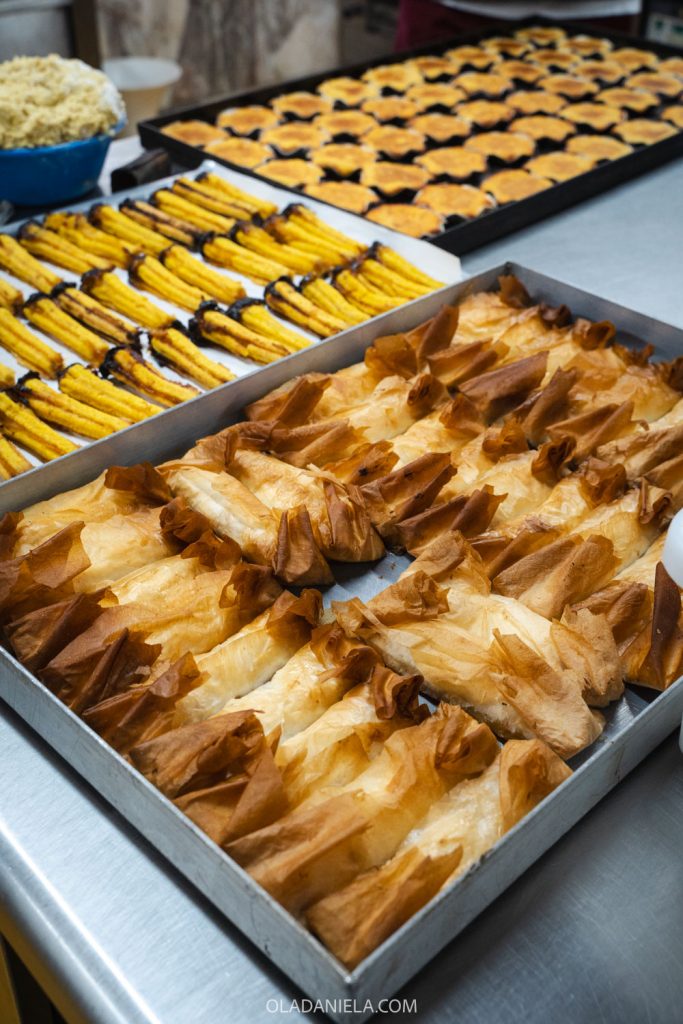
Carmita grabs a sheet of thin pastry, swipes a slick of butter (applied with a chicken feather, no less), adds layers of broken pastry pieces and a generous dollop of sweet egg yolk filling, before rolling and completing an origami-like fold to create the signature log shape.
“With the feather, we guarantee the amount of butter is just right,” says Olga, explaining that a brush would leave too much.
Other pastries to try at Pastelaria Afonso in Tentúgal
Travel Portugal and you’ll soon learn there’s more to traditional sweets than the pastel de nata. As a food scholar, Olga is super passionate about sharing the stories of Portugal’s many convent sweets, and at her family’s bakery they still make a few you’d be hard-pressed to find elsewhere.
When in Tentúgal, you should also try:
Espiga Doce – No other bakery bothers to make this traditional sweet from Montemor-o-Velho. A 4-piece metal contraption is filled with a lemony dough and baked at 400°C (750°F), resulting in a toasted-caramel outside. Each sweet has to be unmolded one by one.
Meia Lua – same ingredients as the pastel de Tentúgal, but the half-moon shape means there’s more doce de ovo filling.
Queijadas de Tentúgal – star-shaped baked cheese (queijo fresco) tart with a thin pastry shell.
Practical tips for visiting Tentúgal
Tentúgal is set along the Rio Mondego river, linking Coimbra with the coast at Figueira da Foz. By car, it’s about a 20-minute drive from Coimbra, 80 minutes from Porto, and 2 hours 15 minutes from Lisbon.
The town itself is super small, but quite cute, and the main reason to visit is to pick up pastries from Afonso or one of the nearby bakeries, most of which are dotted along the National Road 111.
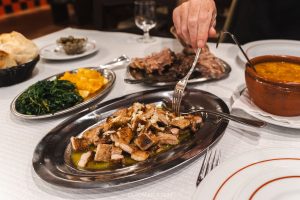
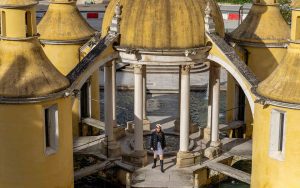
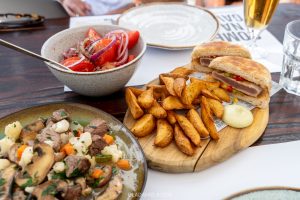
Unless you’re just passing through, I suggest pairing your pastry stop with a trip to nearby Montemor-o-Velho, which has a gorgeous landscaped castle (complete with a playground inside) that towers over the old town. We stopped for a great, traditional Portuguese lunch at Tasca da Mariana there – or, in Tentúgal, Casa Arménio also comes highly recommended.
Enjoyed this article? Support my work and buy me a coffee to say thanks!
October 15, 2026
Daniela Sunde-Brown
I'm an Australian travel and food writer who has called Lisbon home since 2018. To help others explore Portugal, I write deep stories about Portuguese traditions, regional dishes, local artisans, and sustainable fashion and ceramics
I’m an Australian travel and food writer who has called Lisbon home since 2018. To help others explore Portugal, I write deep stories about Portuguese traditions, regional dishes, local artisans, and sustainable fashion and ceramics