
Down in the basement of Diporto time stalled some time around 1955. Wine barrels line the walls of the centenarian taverna where a brusque, elderly gentleman named Mitsos is flipping small fish on a tiny charcoal grill. Large time-worn steel pots bubble away on the stove. It’s said to be the oldest working-class spot near Athens’ central market, open since 1887.
I arrive just before noon – very early by Greek standards – to snag one of the few tables. Inside the smoky room, mostly solo travellers quietly spoon soup, admiring the antique décor found behind an unmarked metal door. Mitsos serves only a few dishes and doesn’t speak English. Ideal. I eat a simple, brothy chickpea soup with a glass of warm, cheap white wine – likely retsina, preserved with pine resin as the ancient Greeks once did.


“To keep tradition alive, you have to break tradition”
Food is at the core of why I travel. In each new place, I start by hunting out the roots of regional cuisine before making reservations at the hottest tables. Traditional cooking always offers context to what hip, young chefs are doing. And as a food-and-culture-obsessed travel writer, I’ll argue that Athens is one of the most exciting places to eat in Europe right now – and it’s a unique mix of old and new that makes me say that.


I recently visited the Greek capital to attend Gastrosophy – a gathering of chefs and thinkers exploring the philosophical side of food. I spent days diving into the city’s culinary landscape, from traditional tavernas and markets to modern family-run Greek restaurants with twists on classic dishes.
For years, Athens has been seen as a layover rather than a destination. A place to pass through en route to the islands. Right now the city is balancing on a fault line between past and present. There’s still a handful of these old-school underground taverns known as koutoukia, serving homely, working-class dishes as they have for generations. But a new guard of young chefs is breathing fresh air into Greek cuisine.


At the festival, Gastrosophy headliner Massimo Bottura, the influential Italian chef behind Osteria Francescana, encouraged local chefs to look at their history with a modern mind and not be afraid to reimagine what it means to eat Greek.

The hunt for (food) history
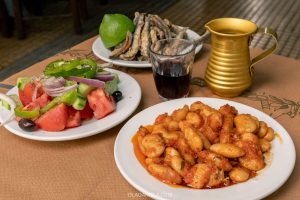
Hours after leaving Diporto, I’m back above ground taking a breather at my hotel – YellowSquare Athens – when a riot of chatter drifts up from Tis theatrou to steki. Over spreads of colourful mezze, I watch a man below cross himself three times. I take it as a sign and abandon my nap plans for my own spiritual experience. Giant beans, horiatiki salad and flash-fried anchovies fill my table as I settle in for a 4pm second lunch and watch the locals talk shit as they knock back ouzo and tsipouro.
Those three small dishes give me change for €10 and yet I can’t finish the lot. Greek food isn’t meant to be eaten alone – another reason I later join a food tour with Culinary Backstreets.


Touring the backstreets of Athens
There’s a trap in being a food-obsessed tourist. You read about amazing, authentic, local places that end up being more mythical than real. So, in any new city, I turn to locals – chefs, food writers and guides. In Athens, I explore Plaka with Culinary Backstreets, which I believe runs the most comprehensive food tours in the world’s greatest culinary cities.
Our guide Constantine leads us on a trail over five or six hours, tasting bougatsa and baklava, dakos and dolmades. We explore traditional Greek coffee culture, taste high-polyphenol olive oils, and sit down for two long-table mezze lunches.


After eight stops and more than 25 dishes, I begin to spot clear links between my Croatian-Australian upbringing and traditional Greek cooking. Greek migration to Australia runs deep, especially after the World Wars. Melbourne is famously the world’s third-largest Greek city – behind only Athens and Thessaloniki – and the influence of this Greek diaspora has shaped everything from our coffee culture to kalamata olives becoming standard fare.
Joining Culinary Backstreets is worth it for the two shared mezze stops alone, where half a dozen dishes landed at once, eaten family-style. The sweet street cat that adopts me at lunch was just a bonus.
Tip: Use my code ‘DANIELA5‘ to get 5% off any tour with Culinary Backstreets.

Read next… Guide to the best food tours in Lisbon
To market, to market
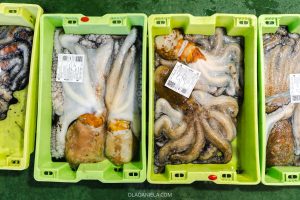
If tavernas tell you how the Greeks eat, markets tell you how they live. Varvakeios Central Municipal Market, Athens’ sprawling fish and meat hall open since 1886, is beautifully loud and chaotic. Here fishmongers shout about the catch of the day while butchers break down beasts on wooden blocks. Neighbouring shops spill into the surrounding streets selling spices, cheese, hardware and even kitchen goods.


I briefly consider a grilled lamb’s head and ouzo at Oinomageireio Epirus, a market taverna that’s been open since 1898. But my sweet tooth leads me to Krinos. Since 1923, this pastry shop has rolled out loukoumades, honey-soaked doughnuts once gifted to ancient Olympic champions. Place orders at the canteen-style counter, hidden at the back, where a young man flips the treats while an older woman serves up five on a metal plate, drowning them in the obligatory honey syrup.
I bite into one and somehow end up with honey through my hair. Around me locals pause between errands while tour groups hover. A mother leaves her twin toddlers at a table while she orders. They swing their legs and giggle as a neighbouring theíā keeps a casual eye on them.


Days later, my market hunt continues. I’m in the inner west looking for Athens’ weekly farmers markets, or laiki agora. There are nearly 200 of these markets across greater Athens each week, a staple of local life where most people buy produce at prices cheaper than supermarkets.
It’s a Tuesday and in Keramikos, stalls overflow with tomatoes, eggplants, citrus and pomegranates. In the next neighbourhood, Aimou Street is packed with produce. Vendors scoop olives and grains by the kilo. A cheese truck idles between apartment blocks. I leave with Greek cucumbers, a huge bunch of dill, and a box of pastries from RIZOS, B, a friendly family bakery that’s been open since 1974.


How modern Athens is redefining Greek food
Athens, a beige sprawl of sun-bleached apartment blocks, uneven pavements and walls layered in graffiti, reminds me of the Lisbon I first landed in back in 2018. But beneath that grit is something electric – and what’s happening in Athens’ kitchens mirrors the streets outside.
“When I’m designing a menu or dish, I go back to my memories and turn them over… they should allow us to dream,” Alex Tsiotinis, executive chef and owner of Michelin-starred Greek restaurant CTC Urban Gastronomy, tells crowds at Gastrosophy.


He echoes the sentiment of Nikos Karathanos, once the youngest Greek chef to gain a Michelin star. Karathanos turned his back on fine dining to plate more democratic dishes at Ateno, a smart modern Greek restaurant co-owned by restauranteur twins Spyros and Vangelis Liakos.
Dining there is a highlight from my time in Athens, where white table linens remain but Greek classics are reworked in unexpected ways. The humble Greek salad becomes theatre. It arrives as a whole, peeled tomato sat on a bed of whipped feta and rusk crumbs. In two quick strikes the waiter splits it open to reveal a colourful mince of cucumber, peppers and onion. While across the city at chef-favourite Seychelles it’s about restraint – a perfect tomato sliced and served with a dollop of the creamiest feta and two rye rusks.


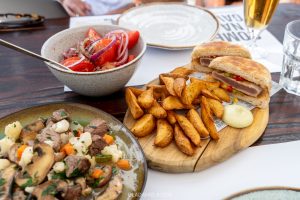
At Manári Taverna, groups of locals soak in the sunshine streetside with bottles of wine while from the steel counter I watch two chefs move around a charcoal grill, flipping taverna staples like kebabs and lamb chops. Nearby Hoocut reimagines souvlaki, the country’s democratic fast food, without pricing out the people who grew up eating it. While out in the suburbs, Travolta stays connected to the Aegean as a once-humble fish tavern turned chic seafood destination.


There’s a restless, creative momentum as chefs look inwards to reimagine Greek food. The result is a capital that honours its past without being trapped by it. And that’s why I believe Athens is one of the best places to eat in Europe right now. So, if you come for the Acropolis, extend your time to eat the streets too.


Where I ate and loved in Athens
Restaurants and tavernas
- Ateno – modern, creative Greek remixed classic in a chic atmosphere
- Manári Taverna – very cool modern Greek taverna working with fire
- Travolta – modern Greek seafood restaurant, focused on what comes from the Aegean
- Seychelles – creative, seasonal Greek taverna that’s a favourite with chefs
- Tis theatrou to steki – super relaxed local mezze spot with small Greek plates
- Karamanlidika – popular deli with simple, classic Greek dishes
- Diporto – centenary basement taverna with simple dishes
- To steki tou Ilia – traditional tavern that specialises in grilled lamb chops


Street eats
- Hoocut – modern gyros or souvlaki spot, taking a street food staple up a notch – I had the lamb and fried squid
- Kostas – my favourite classic souvlaki spot, a local favourite since 1950 – choice or beef or pork with a yogurt sauce. Expect a queue – go early.
- Kosta – classic gyros spot with a tomato sauce. Expect a queue.
- Stani – Athens’ last remaining old-school dairy bar, open since 1931. The yogurt with honey and walnuts!
- Pilino – Greek yogurt bar with all the toppings, including what they call ‘spoon sweets’.
- Pandora – great spanakopita. Greek canteen with homely dishes to eat in or takeaway.
- Feyrouz – Levantine street food
- Krinos – Classic bakery frying up loukoumades since 1923


Where I stayed in Athens
- St George Lycabettus – a classic 5-star hotel at the foot of the famous Lycabettus Hill. I stayed here during Gastrosophy, and it was a great base – with a stunning rooftop pool and unreal views.
- Okupa – really cool modern hotel-hostel concept with a vinyl listening bar, rooftop pool and huge garden. I’d stay here again in a heartbeat.
- YellowSquare Athens – another cool hotel-hostel, though I’d say this one leans more hostel. Worth visiting the incredible rooftop bar with Acropolis views.


Gastrosophy invited me to experience Athens, and I chose to extend my stay independently to develop this story. As always, everything I share is my honest opinion.